Particle (Basic ㊦ 93)
A particle which expresses a limit imposed upon something that is growing and expanding.
Equivalent: Only; just; alone; merely; that’s all
| (i) Noun | だけ {が/を} | |
| 先生だけ{が/を} | The teacher alone {subject/direct object} | |
| (ii) N {Prt だけ/Prt だけ} | (where Prt=particles other than が, を and は) | |
| 先生 {だけに/にだけ} | Only to the teacher/to the teacher alone | |
| (iii) {V/Adjective い} informal | だけ {だ/です} | |
| {話す/話した} だけ {だ/です} | Someone talks/talked, that's all | |
| {高い/ 高かった} だけ {だ/です} | Something is/was expensive, that's all | |
| (iv) Adjective な stem | {な/だった} だけ {だ/です} | |
| {静かな/静かだった} だけ {だ/です} | Something is/was quiet, that's all |
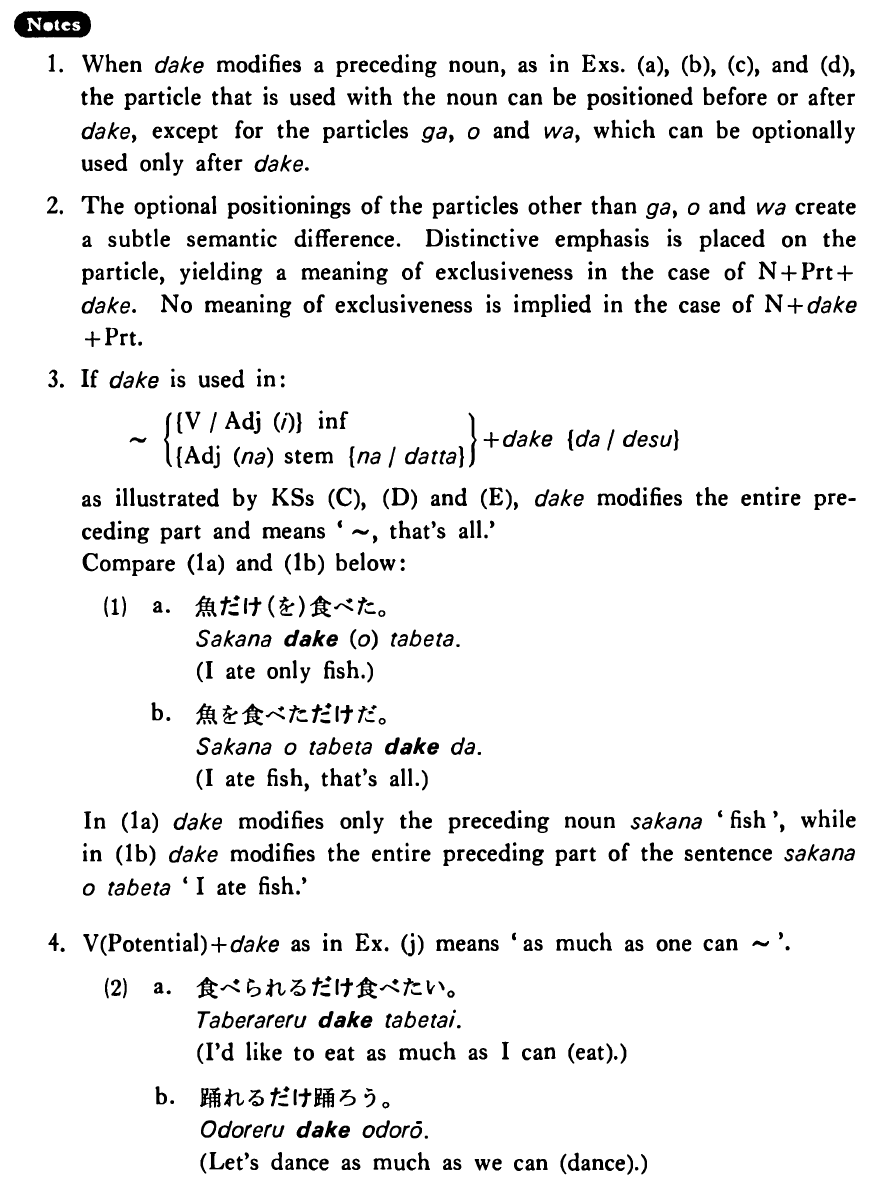
1. When だけ modifies a preceding noun, as in Examples (a), (b), (c), and (d), the particle that is used with the noun can be positioned before or after だけ, except for the particles が, を and は, which can be optionally used only after だけ.
2. The optional positionings of the particles other than が, を and は create a subtle semantic difference. Distinctive emphasis is placed on the particle, yielding a meaning of exclusiveness in the case of Noun+Particle+だけ. No meaning of exclusiveness is implied in the case of Noun+だけ+Particle.
3. If だけ
is used in:| ~ | ⎧{Verb/Adjectiveい} informal ⎫ ⎩{Adjectiveな stem {な/だった}⎭ | +だけ{だ/です} |
as illustrated by Key Sentence (C), (D) and (E), だけ modifies the entire preceding part and means '~, that's all.'
Compare (1a) and (1b) below:
In (1a) だけ modifies only the preceding noun 魚 'fish', while in (1b) だけ modifies the entire preceding part of the sentence 魚を食べた 'I ate fish.'
4. Verb (Potential)+だけ as in Example (j) means 'as much as one can ~'.